
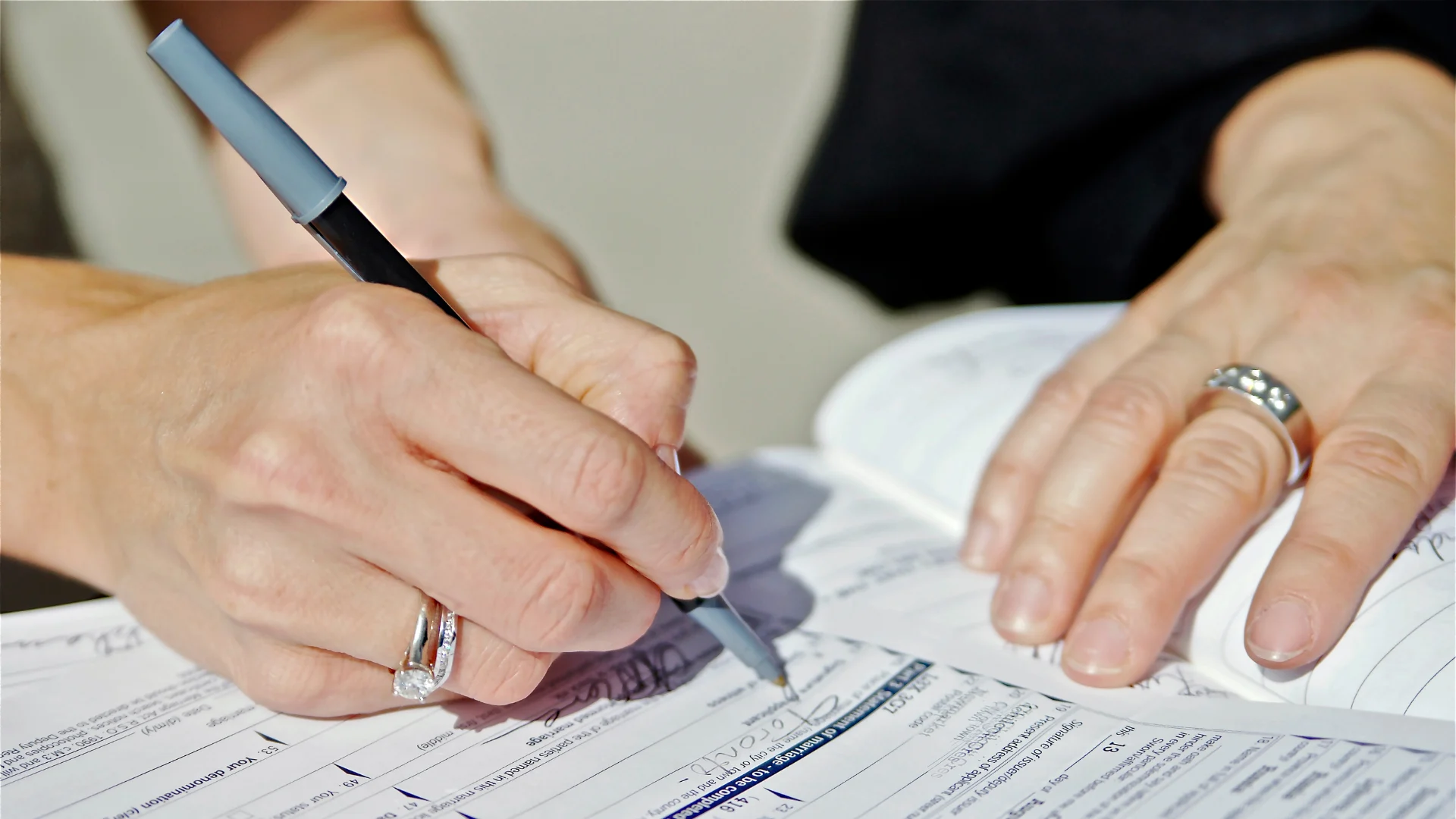
Legal Requirements for Getting Married in Japan as a Foreigner in 2026
Everything you need to know to successfully submit your Konin-todoke (marriage registration) at a Japanese city hall.
- TWO PATHS City hall registration (Konin-todoke) or your home country’s embassy. Only city hall produces an official Japanese government marriage certificate.
-
THREE NON-NEGOTIABLES
• Certificate of No Impediment (or Affidavit of Eligibility)
• Original passport + birth certificate
• Complete Japanese translations (including stamps, fine print, translator’s full name & signature) - TIMING Allow 1–3 hours. Do it a few days before the ceremony — never on the wedding morning.
- CERTIFICATE STYLE Ask specifically for the “Shojo-type” certificate (¥1,400) — the large-format commemorative version on thick traditional paper, perfect for framing.
- PRO TIP Email all documents to the city hall weeks in advance to catch translation errors or an expired Certificate of No Impediment before your wedding day.

Wako is a professional hairdresser with over 15 years specialising in traditional Japanese wedding hairstyles and kimono dressing. She brings deep firsthand expertise in Shinto ceremony etiquette, bridal attire, and Japan's wedding culture and trends.
Follow on Instagram →If you are an engaged couple, the legal side of getting married may seem like a bureaucratic process, just another set of paperwork or even a chore that they must “get through”. But have you ever considered making it a special event that is part of the wedding journey? One that you would look back fondly?
To find out more about the legal process of getting married in Japan, I interviewed Wako Koshigai, who has spent over 15 years as a professional hairdresser specialising in traditional Japanese wedding hairstyles and kimono dressing.
She may not be a lawyer or a government official, but she has accompanied more international brides through the Japanese wedding process than most people. And she has watched what happens when couples are prepared and what happens when they are not.
The legal process for marrying in Japan as a foreigner can be strict, specific, and unforgiving of small errors. But with the right preparation, it is also manageable — and, as Wako insists, it can be genuinely beautiful. This is her guide to making it both.
- Section 1: Two Paths — Choosing How You Legally Marry in Japan
- Section 2: The Three Holy Grails — Documents You Cannot Arrive Without
- Section 3: Timing — Should You Register on Your Wedding Day or Before?
- Section 4: What to Wear to City Hall — A Stylist's Practical Guide
- Section 5: The Special Edition Certificate — Japan's Most Overlooked Wedding Keepsake
- Section 6: What Can Go Wrong — and How to Prevent It
- Section 7: The Pre-Check Strategy — The Single Most Important Step
- Section 8: A Record That Lasts 50 Years
- Section 9: If a New Life Begins in Japan — Two Dates to Remember
- The Spirit of Omotenashi, Even at the Government Window
Section 1: Two Paths — Choosing How You Legally Marry in Japan
The first decision every international couple must make — and the one that determines what documentation you walk away with
The first decision international couples face is which legal pathway to take. There are two primary routes, and the choice between them has practical consequences that ripple through the rest of the wedding planning process.
The Japan Style — Registration at City Hall (Konin-todoke 婚姻届)
The Japan Style involves submitting a Marriage Registration — the konin-todoke (婚姻届) — to a local municipal office. The moment it is accepted, the couple is legally married under Japanese law.
The defining feature of this route is the certificate it produces: the 婚姻届受理証明書 (Konin-todoke Juri Shōmeishō), a Certificate of Acceptance of Notification of Marriage issued by the Japanese government itself. This document is the couple’s only official Japanese proof of their union, and it is irreplaceable.
The city hall route suits couples who want their marriage formally recorded in Japan, who want a date tied specifically to this country, and who want the government-issued keepsake that comes with it.
The Home Country Style — Registration at Your Embassy
The alternative is to complete the process at the couple’s own country’s embassy or consulate in Japan. Under this route, notification to a Japanese city hall is generally not required.
However, Wako flags an important caveat: some international authorities and immigration services may later require additional Japanese documentation, which can create complications down the line for couples who assumed the embassy route was entirely self-contained.
This path suits couples whose home country requires embassy involvement, or who want their marriage registered domestically first and prefer to keep the Japanese administration separate.
If you are planning a ceremony that blends both traditions, read our complete guide to hybrid Shinto-Western weddings in Japan.
The Modern Trend — Legal First, Ceremony Later
There is a third dimension to this choice that Wako considers just as important as the practical one: timing.
“Nowadays, many couples in Japan complete their legal registration months or even years before their ceremony,” she explains.
The trend — accelerated significantly after the pandemic — of becoming a legal family first and planning the dream wedding later has become entirely normalised in Japan. Wako is emphatic on this point.
Couples should not feel pressured to perform both the legal registration and the wedding ceremony on the same day.
In fact, as she suggests that separating the two is almost always the wiser decision. And there is a romantic consolation for those who resist: two separate dates means two separate anniversaries to celebrate every year.
For a complete guide to what happens inside the ceremony itself, read our guide to Shinto wedding ceremonies in Japan.
Section 2: The Three Holy Grails — Documents You Cannot Arrive Without
The Japanese administration is meticulous. Requirements vary slightly by municipality, but as of 2026, three documents are non-negotiable at virtually every city hall in Japan.
Wako calls them the Three Holy Grails, and the description is apt: arrive without any one of them and the entire process stops.
1) The Certificate of No Impediment (婚姻要件具備証明書 — Konin Yōken Gubi Shōmeishō)
This is the most critical document. It proves that the applicant is currently single and legally eligible to marry under the laws of their home country. It is obtained from the home country’s embassy or consulate in Japan, and it comes with a trap that Wako has seen catch couples off guard with heartbreaking regularity: a strict expiration date, most commonly three months from issue.
“We have seen cases where a couple arrives in Japan only to realise their paperwork expired while they were busy planning the party,” — Wako Koshigai.
The certificate must be both valid and current on the day of submission. Obtaining it well in advance and then failing to check the date before travelling is one of the most avoidable mistakes in this entire process.
2) Passports and Birth Certificates
Original documents — not photocopies — are required to verify identity and nationality. This point is straightforward but worth stating clearly: the originals must be physically present at the counter.
Municipal offices will not accept scanned or printed copies as substitutes for original documents.
3) Japanese Translations — The Most Overlooked Requirement
Every single foreign-language document must be accompanied by a complete Japanese translation. This is the requirement that trips up more couples than any other, and the reason is a widespread misunderstanding of what “complete” actually means.
“In Japan, you must translate everything on the document,” Wako explains. “This includes small official stamps, titles of the signing officers, and even the fine print on the back of the certificate. If you skip something because you think it is unimportant, the official will likely reject the document for being incomplete.”
There is also a specific accountability requirement that many couples miss. While the translation can be performed by anyone — including the couple themselves — the Japanese government requires the translation to include a statement at the bottom containing the translator’s full name, address, and signature.
Without this proof of translator, the document has no legal standing regardless of how accurate the translation itself may be.
Katakana Consistency
And then there is the katakana consistency trap. In Japan, foreign names must be rendered in katakana — the Japanese phonetic script used for foreign words — and that rendering must be absolutely identical across the marriage registration form, the original certificate, and the translation.
A single character difference between how a name has been registered previously (perhaps on a visa or work permit) and how it appears on the marriage form can flag the system and stop the process for hours while officials verify identity.
As of 2026, these three documents are non-negotiable at virtually every city hall in Japan. Arrive without any one of them and the entire process stops.
For help finding a qualified translation service before you arrive, read our guide to where to get wedding documents translated in Tokyo.
Section 3: Timing — Should You Register on Your Wedding Day or Before?
This is the question Wako answers with her own story.
The Puffy-Faced Bride — A Confession
“I have a confession,” she begins. “On my own wedding day, I was so stubborn about having the same date for my registration and my ceremony that I went to the city hall at the crack of dawn on my wedding morning.”
The result was a great memory, she acknowledges — but she walked down the aisle with a very puffy face from lack of sleep and stress.
It is the most persuasive argument she makes in this entire guide, and she makes it with characteristic directness: the best beauty serum for a bride is a good night’s sleep and a calm mind.
Spend the wedding morning with your stylist, not rushing through government offices.
The practical reality reinforces the personal one. Finishing the city hall registration in 30 minutes is, as Wako puts it bluntly, almost impossible.
Unlike registration for Japanese nationals, the marriage of two foreign nationals requires what city hall officials call a Substantive Examination — a process in which the official must verify the submitted documents against the specific laws of each applicant’s home country to ensure the marriage is legally valid in both nations.
Officials must consult legal manuals and government circulars, manually create digital records since foreigners have no Family Register, and cross-check every line of the Japanese translations for accuracy.
How Long Does It Actually Take?
With documents pre-checked and approved in advance: one to one and a half hours.
A standard walk-in with no prior contact: two to three hours.
If errors are found, or if the office is busy: three or more hours, and potentially not completed that day at all.
The 24-hour window — the night and holiday drop-off slot available at most city halls — is similarly unreliable for international documents.
No specialised staff are present to verify foreign paperwork at four in the morning, and if there is an error, the registration date will be pushed back regardless of how early the form was dropped off.
Wako’s recommendation: do the paperwork a few days before the ceremony.
If a couple is determined to share the same date for both their registration and their ceremony, she insists on one non-negotiable condition — the pre-check must be completed weeks in advance, with zero errors remaining.
Otherwise, the romantic ideal of a shared date may cost the bride her sleep, her skin, and her composure before the day has even begun.
Section 4: What to Wear to City Hall — A Stylist’s Practical Guide
For a professional whose entire working life revolves around how brides look, Wako’s advice on city hall attire is strikingly pragmatic. Smart casual is the only option. Wedding attire at a municipal office is essentially unheard of in Japan, and for good reason.
Respecting the Public Space
Japanese culture places enormous emphasis on what is known as TPO — time, place, and occasion. A city hall is a shared public space where people arrive for many different purposes: some administrative, some celebratory, and some deeply sad.
Showing up in a wedding gown or formal tuxedo is considered inconsiderate of that shared environment.
It is also, from a purely practical standpoint, unnecessary risk.
Wedding gowns and formal suits are delicate, expensive, and easily damaged — wrinkling or staining either during travel or while waiting on plastic office chairs would be a costly and entirely avoidable disaster.
Wako’s Three Rules for the Registration Morning Outfit
From her own experience and from years of preparing brides for city hall mornings, Wako has distilled her advice into three rules:
A Practical Outfit
The first, and the one she calls her most important: wear a button-down or zip-up top. The reason is entirely practical. Professional hair and makeup will almost certainly begin immediately after returning from the city hall.
A top that can be removed by opening at the front — rather than pulled over the head — means that freshly styled hair stays intact and newly applied makeup stays unsmudged. It is the kind of detail that only a stylist would think to mention, and it makes an enormous difference.
Photography
The second rule is about photography. Despite the smart-casual requirement, the city hall visit is a commemorative moment and most couples will want a photograph — at the office window, or in front of the building.
Wako recommends a nice white blouse or a simple dress: something that reads as intentional and lovely in a photo without feeling out of place in a government building. “You want to look like a bride-to-be,” she says, “without being over-the-top.”
Comfortable Shoes
The third rule is the simplest: wear comfortable shoes. The rest of the day will be spent in heels or formal footwear. The city hall trip is an opportunity to conserve energy and protect the feet for the long hours ahead.
For expert advice on what to wear for the ceremony itself, read our guide to choosing between a Shiromuku, Iro-Uchikake, and a modern wedding dress.
Section 5: The Special Edition Certificate — Japan’s Most Overlooked Wedding Keepsake
Of all the practical advice Wako offers in this guide, the one she is most enthusiastic about is also the one most couples never think to ask for.
When the marriage registration is accepted at city hall, the couple is entitled to receive the 婚姻届受理証明書 (Konin-todoke Juri Shōmeishō) — the Certificate of Acceptance of Notification of Marriage. This document is their only official Japanese government proof of the marriage, and it comes in two versions.
The standard version is a plain A4 sheet, functional and unremarkable, issued for approximately ¥350.
The second version — which Wako recommends without exception — is what she calls the Shojo-type: a large format commemorative certificate printed on thick traditional Japanese paper with beautiful decorative borders, for approximately ¥1,400.
It is elegant, distinctive, and the kind of document that belongs in a frame rather than a filing cabinet.
The critical piece of advice is how to ask for it. “If they just ask for the certificate,” Wako warns, “they might receive a plain A4 paper used for tax purposes.”
The couple must specifically request the Shojo-type at the counter. That single word — Shojo-type — is the difference between receiving a bureaucratic form and receiving a beautiful keepsake that represents the full weight of what has just happened: a legal union, recorded by the Japanese government, on paper befitting the occasion.
To understand how registration costs sit within your overall wedding budget, read our complete Japan destination wedding cost guide.
Section 6: What Can Go Wrong — and How to Prevent It
Most delays and rejections at Japanese city halls are not caused by genuine legal problems. They are caused by clerical mismatches, overlooked details, and administrative oversights that are, in almost every case, entirely preventable. Wako has seen the full range:
Translation Errors
The translation mistakes that stop couples at the counter fall into three categories.
The first is incomplete translation — skipping official stamps, fine print, or officer titles because they seem unimportant.
The second is a missing accountability statement — the translator’s full name, address, and signature must appear at the bottom of every translated document.
The third is katakana inconsistency — any difference between how a name appears across the marriage form, the original certificate, and the translation will trigger a verification process that can take hours.
The Local Rule Trap
Japan’s municipal offices operate with a degree of independence that surprises many international couples. Requirements for the same nationality can differ between a ward office in Tokyo and a city hall in Karuizawa. Assuming that rules are consistent across the country is a mistake.
Every couple should confirm the specific requirements directly with the office where they plan to register, and never rely on information gathered from a different location.
Pending Is Not Rejected
If the office places an application on hold for a legal check — most commonly because recent changes in a home country’s marriage laws mean the local office’s manual is outdated, requiring a call to the Ministry of Justice for a formal ruling — it does not mean the couple is not married.
“Pending is not rejected,” Wako says. “It just means the bureaucracy needs time to catch up.” The couple should not allow a pending stamp to diminish the joy of their ceremony. The legal outcome, in almost all such cases, is the same — it simply takes longer to arrive.
Most delays and rejections at Japanese city halls are not caused by legal problems. They are caused by clerical oversights that are entirely preventable with the right preparation.
Section 7: The Pre-Check Strategy — The Single Most Important Step
If there is one piece of advice that runs through every section of this guide, it is this: use the pre-check.
Before the wedding, weeks in advance, email the complete set of documents to the city hall where the registration will take place and ask for a formal document review. Japanese officials are meticulous, and they will identify every error, every missing element, and every inconsistency before the couple arrives in person.
The pre-check is what separates a smooth, joyful registration from a heartbreaking rejection on the morning of a wedding.
It is also, as Wako notes, the non-negotiable condition for anyone determined to combine their registration with their ceremony on the same day.
Without it, the risks of the same-day approach are simply too high. With it, the process becomes as reliable as careful preparation can make any bureaucratic process — which, in Japan, is very reliable indeed.
The difference between a smooth, joyful registration and a heartbreaking rejection on your wedding morning comes down to one thing: whether you pre-checked your documents.
Section 8: A Record That Lasts 50 Years
Because non-Japanese citizens do not have a Family Register (Koseki) in Japan, some couples worry that their marriage record will disappear — that the evidence of this legal moment, witnessed and recorded in a foreign country, might eventually cease to exist.
The reality is the opposite.
Japanese municipal offices preserve submitted marriage registrations for 50 years. Decades from now, a couple could return to Japan with their children or grandchildren and visit the very office where their union was officially recorded.
The record will still be there.
It is, as Wako describes it, a cinematic way to reconnect with history. And it reflects something genuine about Japanese institutional culture — a commitment to record-keeping and preservation that extends even to the marriages of foreign nationals who will likely never live in Japan.
They may never return, but their decision to bind themselves to this country through its legal system is treated as worthy of careful, lasting documentation.
Section 9: If a New Life Begins in Japan — Two Dates to Remember
For couples who are staying in Japan beyond the wedding, or who find themselves expecting a child during their time in the country, Wako offers a final practical note. Two deadlines apply to newborns born in Japan, and both are strict.
The birth must be reported at city hall within 14 days.
The baby’s visa application must be submitted to the Immigration Bureau within 30 days.
Keeping these dates ensures that a new family can remain in Japan with complete legal peace of mind, without the complications that arise from missed administrative deadlines.
Once the paperwork is done, choose the ceremony that fits you. Our guide to Japanese wedding ceremonies compares each style.
The Spirit of Omotenashi, Even at the Government Window
The spirit of Omotenashi — Japanese hospitality in its deepest sense, the anticipation of a guest’s needs before they are expressed — is not something most people expect to encounter at a government counter.
But Wako insists it is there.
Japanese officials who work with international couples understand the weight of what they are processing. The care with which they examine documents, the thoroughness of the substantive examination, the 50-year preservation of records — all of it reflects an institutional seriousness about the significance of marriage that, once encountered, is hard to forget.
With precise preparation, the legal registration does not have to be a chore standing between a couple and their wedding day.
“Choosing to legally marry in Japan is more than just a bureaucratic process,” she says. “It is a unique journey that creates a lifelong bond with this country.” – Wako Koshigai.
It can be — as Wako has seen it become for the couples she has worked with, and as she experienced herself, puffy face and all — a beautiful and memorable part of the journey. The paperwork, done right, becomes part of the story.
For help choosing the right time of year, read our guide to Japanese wedding seasons.
Legal Requirements for Getting Married in Japan as a Foreigner in 2026
Clear answers to the most common questions about Konin-todoke and city hall registration.
Can foreigners legally get married in Japan?
What documents do foreigners need?
• Certificate of No Impediment (or Affidavit)
• Original passport + birth certificate
• Full Japanese translations (including stamps & fine print) with translator’s name, address & signature.
Do I need to go to city hall on my wedding day?
How long does city hall registration take?
Pre-checked documents: 1–1.5 hours.
Walk-in: 2–3+ hours. Errors may require return visit.
What is the special edition marriage certificate?
What are the most common mistakes?
• No translator name/address/signature
• Expired Certificate of No Impediment
• Katakana name spelling mismatch
What does “pending” mean?
What should I wear to city hall?
How long are Japanese marriage records kept?
About the Contributor
Wako Koshigai is a professional hairdresser with over 15 years of experience specialising in traditional Japanese wedding hairstyles and kimono dressing. With deep knowledge of Japan’s wedding culture and trends, she has worked with both Japanese and international couples across the country’s most celebrated venues, shrines, and heritage settings.

Timothy is a web builder and marketing specialist with a deep passion for Japan and its culture. He founded Get Married in Japan to help international couples navigate Japan's wedding traditions — and to connect them with the people who know it best.
Connect on LinkedIn →