
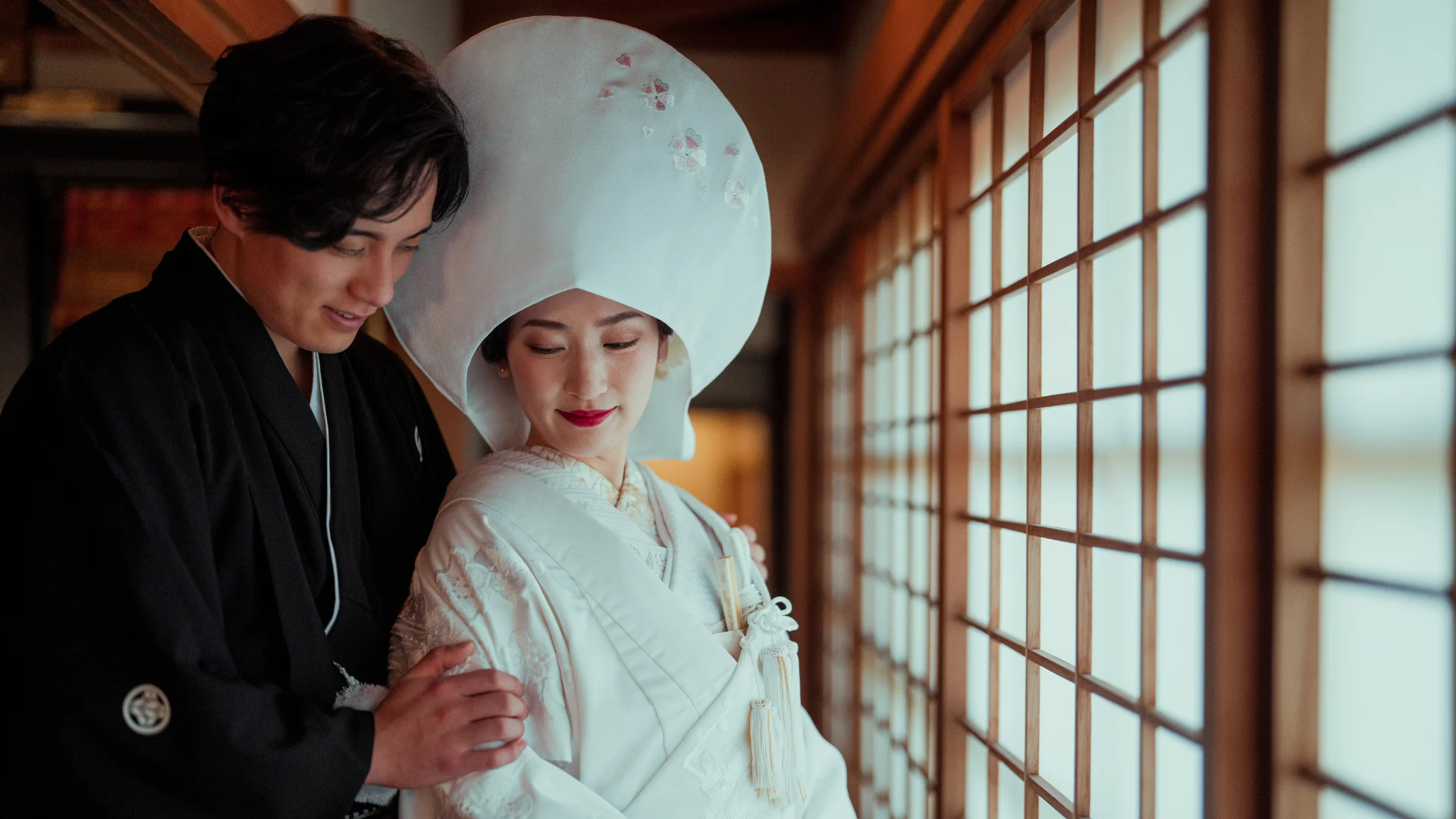
- Shinto Wedding (Shinzen-shiki): Traditional shrine ceremony where the couple is blessed by the kami through rituals, not personal vows.
- Duration: ~30 minutes. Follows fixed sequence: procession, purification, prayers, san-san-kudo, tamagushi offering & ring exchange.
- San-san-kudo: Emotional heart of the ceremony — nine sips of sake from three cups, symbolizing complete sharing in marriage.
- Legal Status: Not legally binding. Official marriage requires separate konin-todoke registration at city hall (before or after the ceremony).
- Best Shrines for Foreign Couples: Meiji Jingu (Tokyo), Yasaka Shrine (Kyoto), Hie Shrine (Tokyo) — all offer English coordinators.

Wako is a professional hairdresser with over 15 years specialising in traditional Japanese wedding hairstyles and kimono dressing. She brings deep firsthand expertise in Shinto ceremony etiquette, bridal attire, and Japan's wedding culture and trends.
Follow on Instagram →
Most of us have been to Western Style Weddings. As a Singaporean, I’ve had the opportunity to attend Chinese, Indian and Malay weddings as well. That thought me thinking: “I wonder what a Traditional Japanese Wedding” looks like?
So to find out more, I interviewed Wako Koshigai, a professional hairstylist who has spent over 15 years dressing brides for Shinto ceremonies across Japan.
She talks about her experience having worked on Shinto weddings, how the ceremony unfolds, what’s worn, where to have one, and what international couples need to know before booking.
- What Is a Shinto Wedding Ceremony?
- What’s the difference between Shinto & Western Weddings?
- Step by Step of the Shinto Wedding Ceremony
- What do the Bride and Groom Wear in a Shinto Wedding?
- Where to Have a Shinto Wedding Ceremony?
- Planning a Shinto Wedding as an International Couple
- So, is a Shinto Wedding Ceremony Right for You?
- Closing
What Is a Shinto Wedding Ceremony?

At its core, a Shinto wedding is about community and spiritual blessing rather than individual declaration. While a Western wedding centres on the couple speaking their own vows to each other, a Shinto wedding centres on a priest formally announcing the marriage to the kami and asking for their blessing on the union.
The couple’s commitment is expressed through shared ritual rather than spoken promises. In Japanese, this ceremony is formally called shinzen-shiki (神前式), literally meaning “ceremony before the gods.”
The version practised today took its modern form following the 1900 wedding of the future Emperor Taisho, which was conducted in a Shinto style and quickly became the model the public adopted for their own weddings.
The ritual elements themselves such as the purification, sake sharing, offerings to the kami draw on much older Shinto religious practice. What changed in 1900 wasn’t the invention of something new, but the popularisation of a specific ceremonial format that has remained largely unchanged since.
“Most foreigners are shocked when I tell them the white kimono Shinto wedding as we know it is only about 125 years old,” Wako says. “It became the symbol of a new Japan — modern, yet deeply connected to the kami.”
What’s the difference between Shinto & Western Weddings?
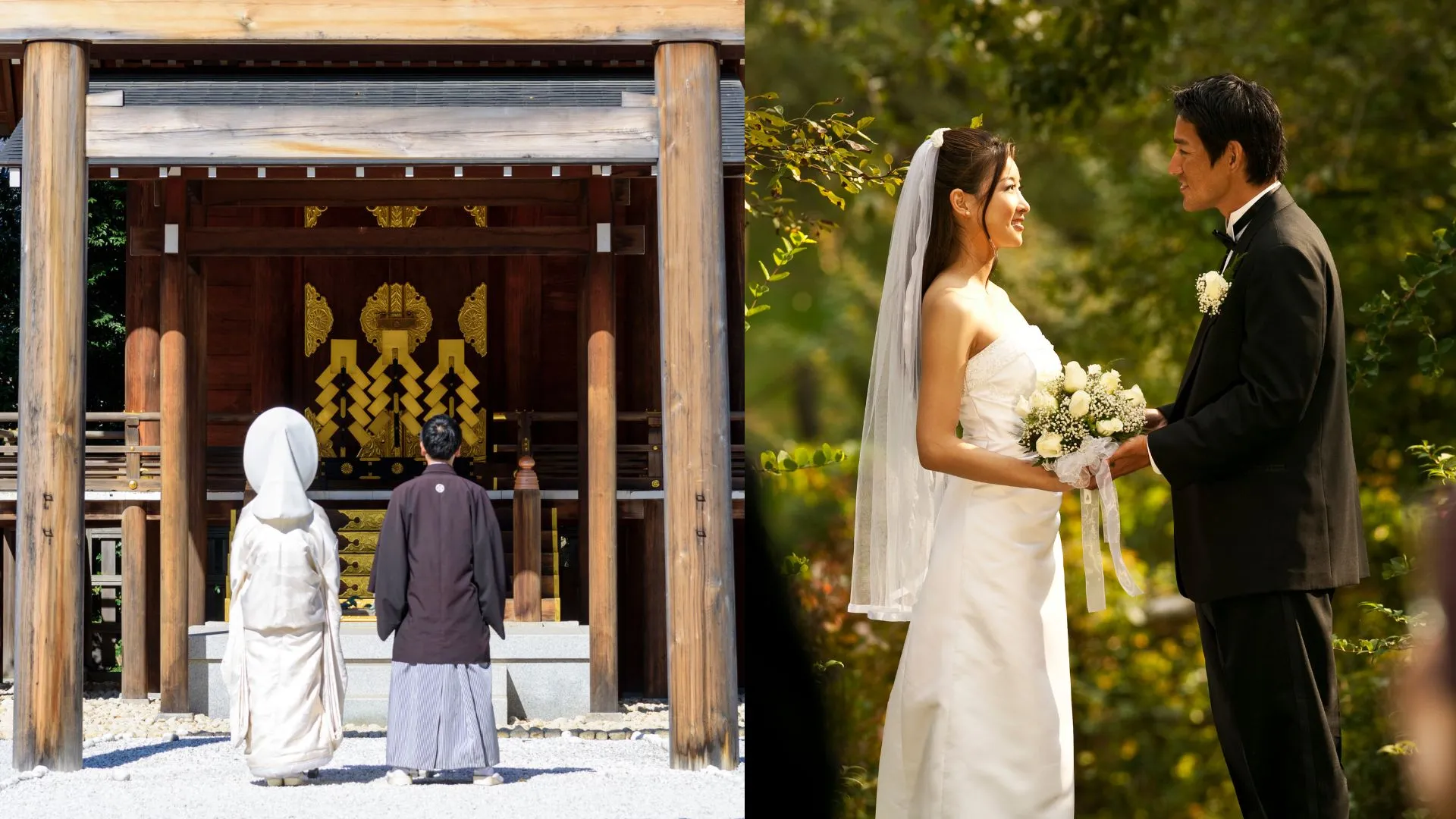
Three things separate a Shinto wedding from a Western ceremony most clearly.
The spiritual focus shifts from personal vows to communal blessing. The couple isn’t “performing” for an audience, they’re being formally recognised by the kami with their families as witnesses.
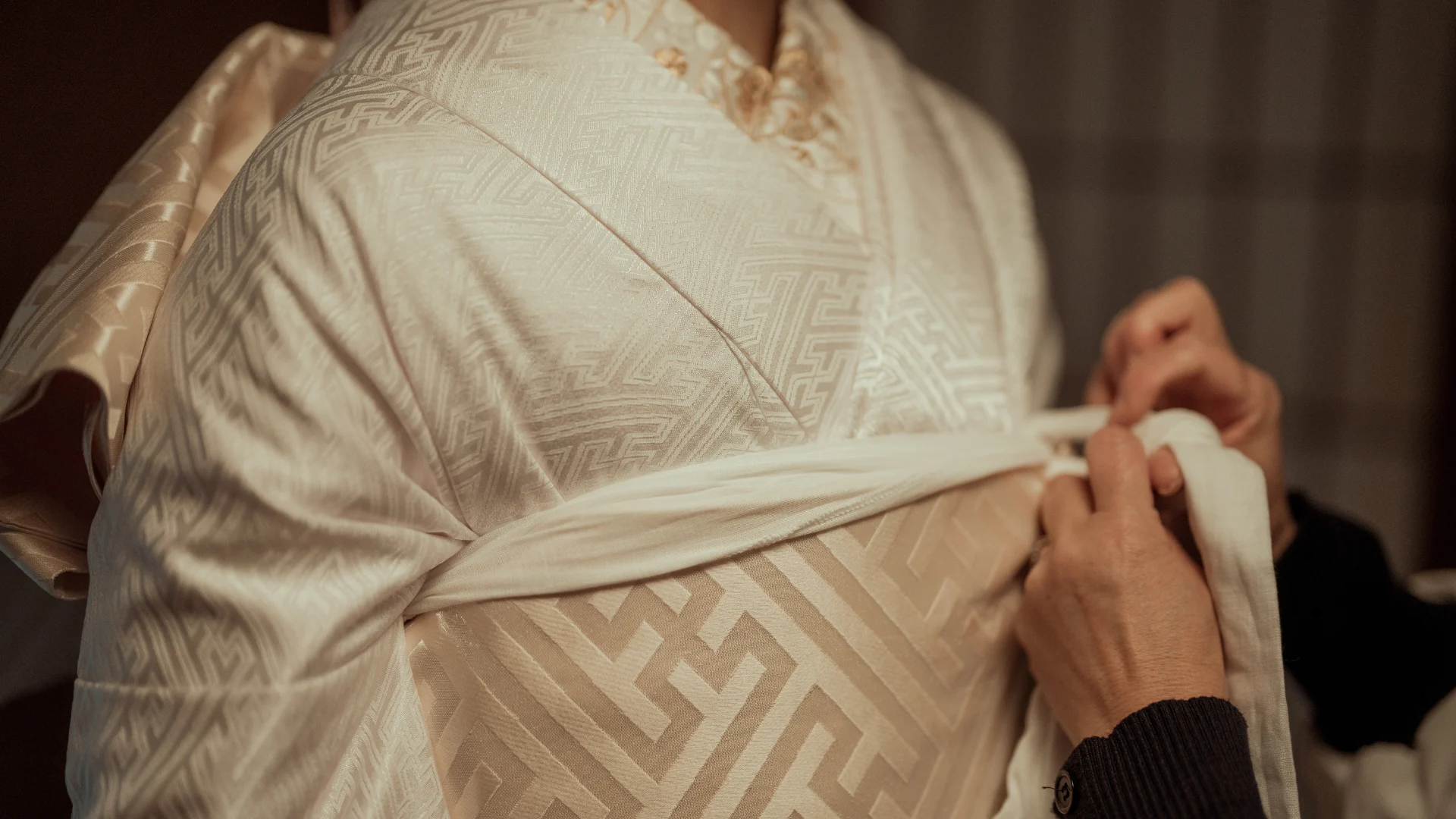
The attire shifts from a white dress and suit to the shiromuku and tsunokakushi for the bride and the montsuki hakama for the groom, both rooted in centuries of Japanese textile tradition rather than contemporary fashion.
And the venue shifts from a church or banquet hall to the shrine grounds themselves. Usually surrounded by trees, gravel paths, and the specific quiet that comes from being inside a sacred space rather than a rented one.
None of this makes a Shinto wedding more or less valid than a Western ceremony. It’s simply built around a different idea of what a wedding is for.
If you want the cultural depth of a Shinto ceremony alongside elements of a Western wedding, read our complete guide to hybrid Shinto-Western weddings in Japan.
Step by Step of the Shinto Wedding Ceremony
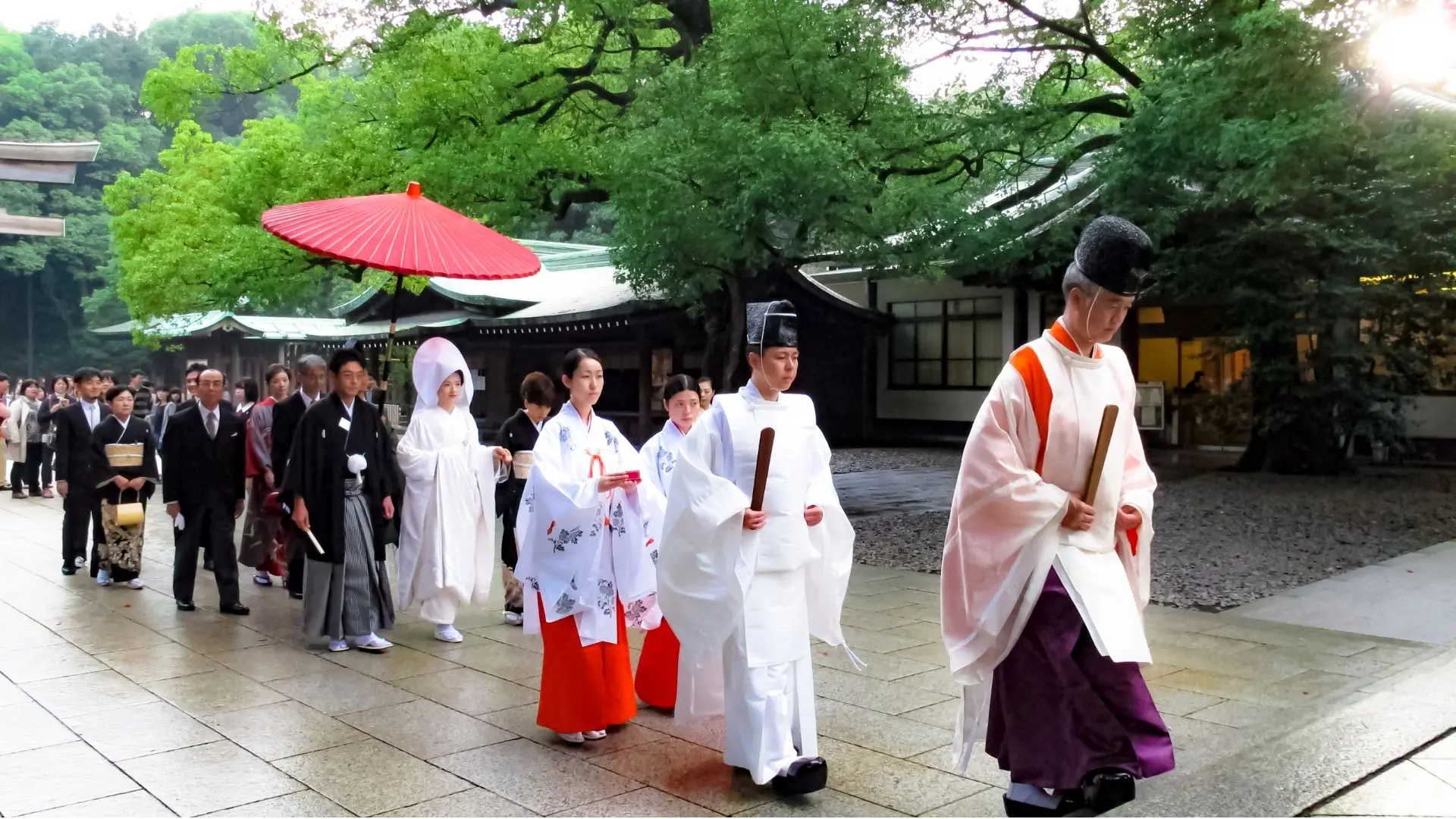
A Shinto wedding may be deliberately short at around 30 minutes, but every part of it carries weight.
It begins with a formal procession into the shrine grounds, the couple and their families walking together under the torii gates in silence. There is no music being played so you only hear footsteps on the gravel.
A priest then performs shubatsu, a purification ritual using a haraegushi wand of white paper streamers, cleansing everyone present before the ceremony continues.
The priest recites norito, prayers reporting the marriage to the kami and asking for their blessing.
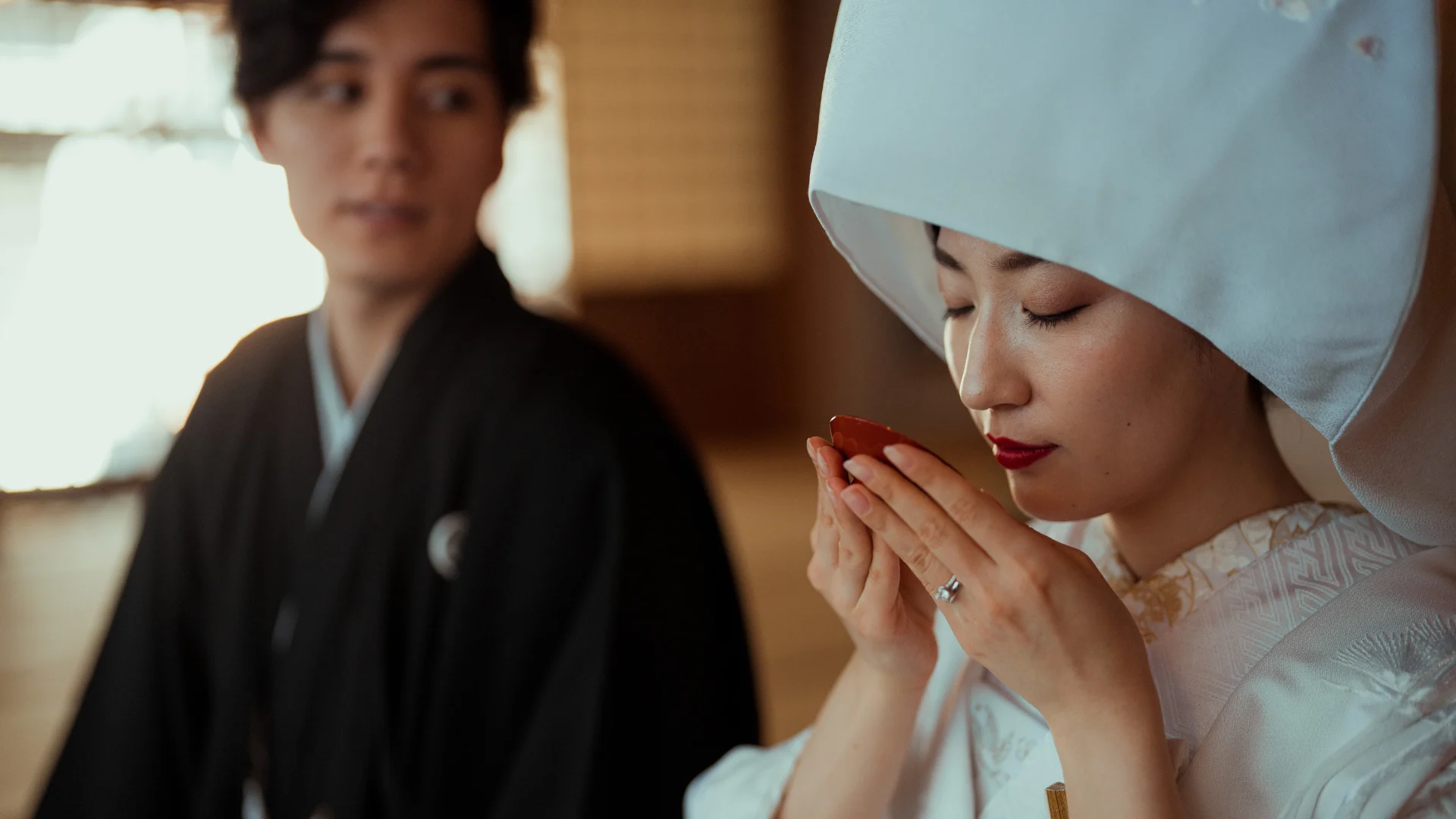
Then comes san-san-kudo, the part of the ceremony most people remember afterward. Three lacquered cups, increasing in size, are presented to the couple. The bride sips three times from the smallest, then the groom, then they repeat with the medium cup, then the largest. Nine sips total.
“There is no kiss, no ‘I do,'” Wako explains. “The marriage is sealed when they drink from the same cups. The different sizes represent life’s ups and downs — you will share everything, good and bad.”
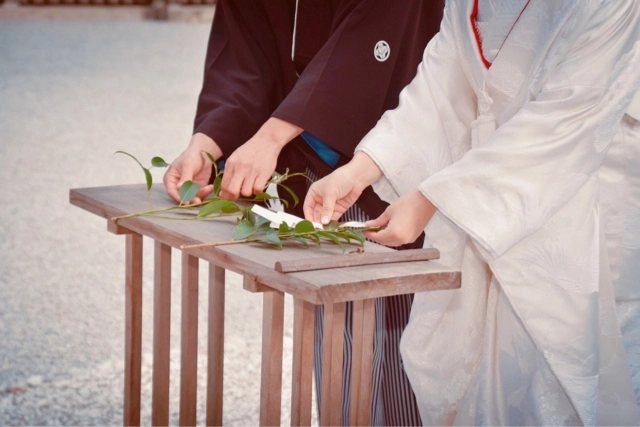
The couple then offers tamagushi, a sacred sakaki branch, to the shrine as a gesture of gratitude. A ring exchange often follows, though this is a modern addition rather than part of the original ritual. The ceremony closes with two bows, two claps, and a final bow. And at that point, they are married.
“That silence at the end,” Wako reflects, “that’s when most brides start crying. Not during the ceremony, but when they realise what just happened.”
See the full step-by-step Shinto ceremony flow in our Japanese Wedding Ceremonies guide.
What do the Bride and Groom Wear in a Shinto Wedding?
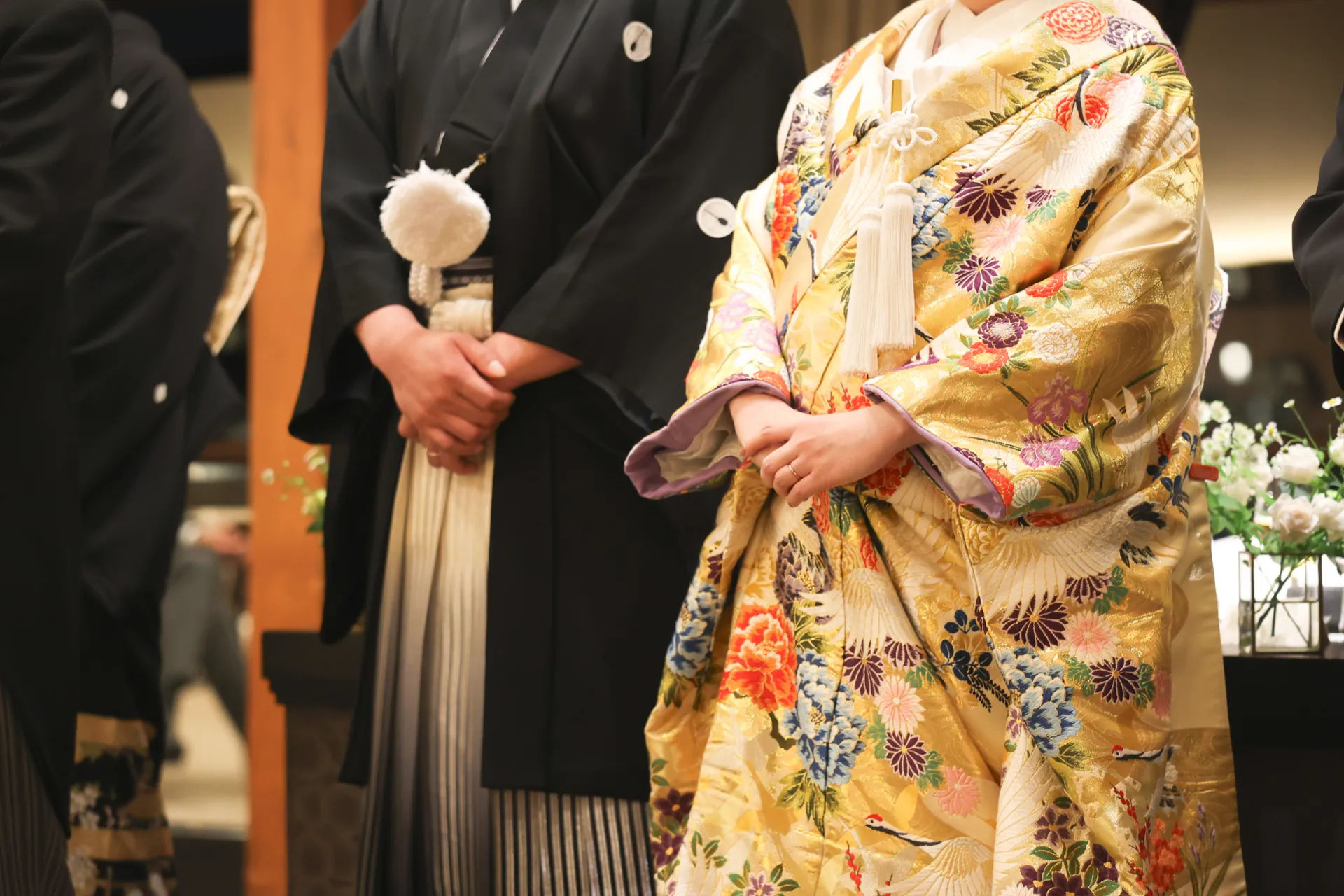
In a traditional japanese wedding, the bride wears a shiromuku. It is a heavy, layered, pure white kimono that can weigh 10 to 15 kilograms once fully assembled. It is also paired with a tsunokakushi headdress.
The white represents purity and a readiness to take on the colours of the new family. The groom wears a montsuki hakama, a formal black kimono that carries its own quiet dignity.
“International brides always panic about the weight and the heat,” Wako laughs. “But the moment they see themselves in the mirror, they forget everything. I’ve never had one complain once the photos come back.”
This is only a brief introduction as the shiromuku alone has enough history, styling detail, and practical considerations to fill an entire guide of its own.
Read our complete guide to the shiromuku for everything on the garment, the headpiece decision, and what wearing one actually feels like.
Where to Have a Shinto Wedding Ceremony?
After dressing brides at dozens of shrines, here are some of Wako’s reccomendations for international couples:
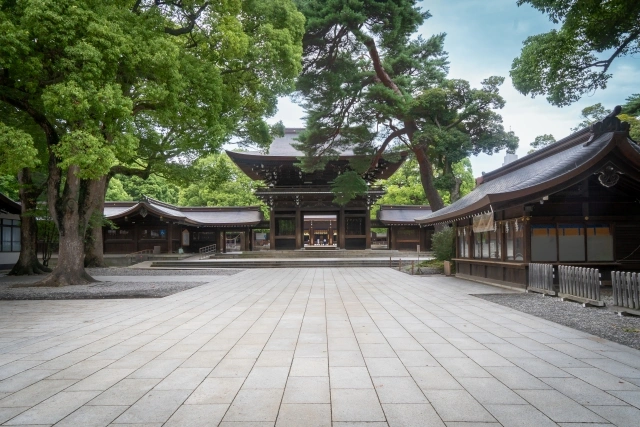
Meiji Jingu in Tokyo sits inside 70 hectares of forest in the middle of the city. It has total silence, English-speaking priests on staff, and is usually the most requested shrine among the couples she works with.
Its popularity is also its limitation: only two or three ceremonies run per day, so it books out fast.
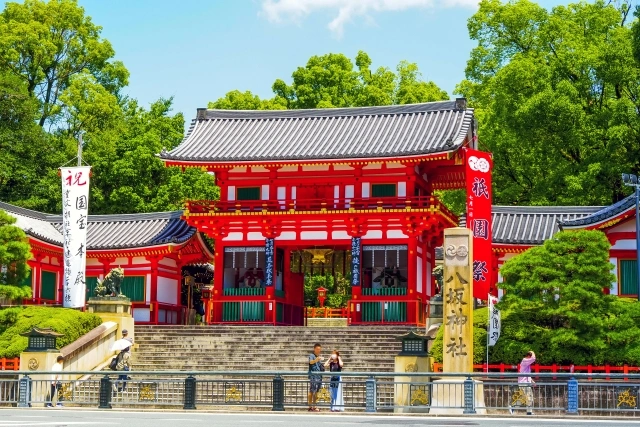
Yasaka Shrine in Kyoto offers the most visually striking setting of the three. The vermilion gates and lanterns are excellent for couples timing their wedding around cherry blossom or autumn leaves. They provide full English coordination, though shrine fees run slightly higher than the Tokyo options.
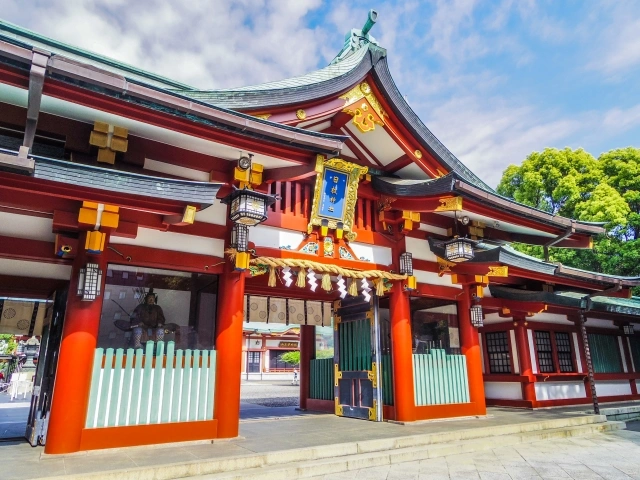
Hie Shrine in Tokyo is the most intimate of the three, with easier booking windows and a famous red torii tunnel that photographs beautifully, set in the middle of the city with a hidden-gem atmosphere despite smaller grounds than Meiji Jingu.
Beyond these three, smaller and lesser-known shrines across Japan are often more flexible for international couples as they are more willing to accommodate hybrid elements, external photographers, and unconventional requests than the famous landmarks, which run on tighter, more standardised schedules.
For a broader look at ceremony styles and venue options across Japan, read our Japanese Wedding Ceremonies guide.
Planning a Shinto Wedding as an International Couple
Wako suggests firstly choosing a shrine with English-speaking coordinators where possible. All three shrines mentioned above offer this, but it’s worth confirming directly for smaller or regional shrines.
Secondly, Wako recommends booking 12 to 18 months ahead for popular seasons, particularly April and November, when both cherry blossom and autumn foliage drive demand sharply upward.
Thirdly, do a full kimono fitting and hair trial before the day itself. The first time in a shiromuku can be overwhelming, and a trial run removes that surprise from the actual wedding morning.
Most shrines now discreetly allow a small bench for couples who find seiza kneeling difficult to hold for the ceremony’s duration, so it’s worth asking rather than assuming you’ll need to manage without one.
Lastly, choose a photographer who understands shrine etiquette specifically. Flash photography and loud directions are forbidden inside the worship hall, and a photographer unfamiliar with this will either miss the shot or disrupt the ceremony trying to get it.
Read our guide to wedding photographers in Japan for advice on finding someone who understands shrine etiquette.
One distinction worth understanding clearly is that the Shinto ceremony itself has no legal standing in Japan. The marriage is only made official through a separate registration at a city hall something couples can complete months before or after the ceremony itself.
Read our complete guide to legal requirements for getting married in Japan as a foreigner.
So, is a Shinto Wedding Ceremony Right for You?
It’s right for you if you’re drawn to ritual over performance. If the idea of being married through shared sake and silence appeals more than speeches and a first dance.
It’s right for you if a setting that feels genuinely ancient matters more than one built specifically for weddings.
And it’s right for you if you’re comfortable with a ceremony where your families witness something happening to you, rather than one where you “perform” something for them.
Consider other options if writing and exchanging your own vows is the part of a wedding ceremony that matters most to you as a Shinto ceremony doesn’t really offer that moment in the way a Western or garden ceremony does.
The same applies if kneeling in formal kimono for an extended period sounds more stressful than meaningful, or if your guest list and vision simply suit a different kind of venue.
One Australian bride summed it up after her ceremony last spring: “We didn’t say a word to each other the entire time, yet I’ve never felt more married.”
Not sure a Shinto ritual is right for you? Compare all four types of Japanese wedding ceremony, from shrine to chapel to garden.
Closing
A Shinto wedding doesn’t ask you to perform anything. It asks you to be still, to drink from the same cup, and to let several centuries of ritual do the talking. For the couples who choose it, that’s usually exactly the point.
For help finding a shrine, coordinating with English-speaking staff, and planning every detail of a Shinto wedding from overseas, our local planning network can guide you through the full process.
Shinto Wedding Ceremonies — Frequently Asked Questions
Everything you need to know about traditional Shinto wedding ceremonies in Japan.
What is a Shinto wedding ceremony?
How long does a Shinto wedding ceremony last?
Do you have to be religious or Japanese to have a Shinto wedding?
What is the san-san-kudo ritual?
How much does a Shinto wedding cost?
Can foreign couples have a Shinto wedding in Japan?
Is a Shinto wedding ceremony legally binding?
About the Contributor
Wako Koshigai is a professional hairdresser with over 15 years of experience specialising in traditional Japanese wedding hairstyles and kimono dressing. With deep knowledge of Japan’s wedding culture and trends, she has worked with both Japanese and international couples across the country’s most celebrated venues, shrines, and heritage settings.

Timothy is a web builder and marketing specialist with a deep passion for Japan and its culture. He founded Get Married in Japan to help international couples navigate Japan's wedding traditions — and to connect them with the people who know it best.
Connect on LinkedIn →